
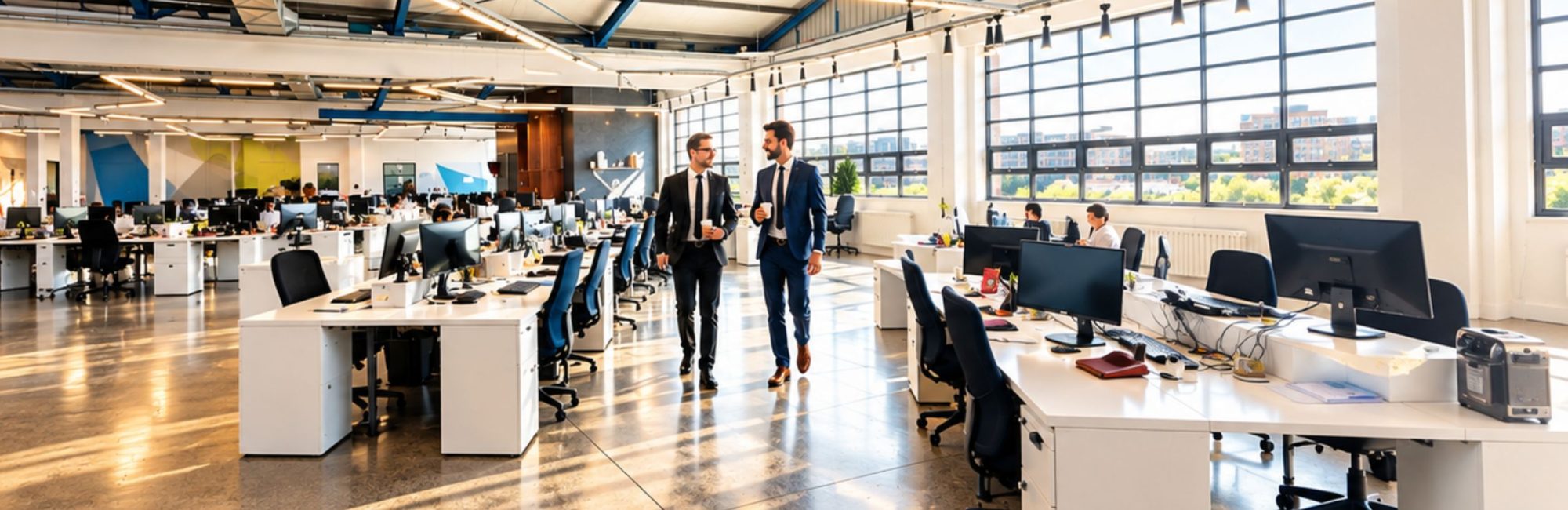
For decades, the trajectory of a successful business and the trajectory of its office size were assumed to move in the same direction. Growth meant more staff, more staff meant more desks, and more desks meant a bigger footprint. A business that moved into a smaller space was almost automatically read as a business in decline, cutting costs because it had no other choice, scaling back ambition along with square metres. This assumption is now badly out of date, and a growing number of genuinely successful, well run businesses are quietly proving it wrong. They are choosing smaller offices, not because they have to, but because a smaller, more deliberately designed space often serves them considerably better than the larger footprint they previously occupied. This is not retreat. It is a calculated, confident decision, and the businesses making it are generally not the ones struggling. They are often the ones growing fastest, precisely because they have stopped treating office size as a proxy for success and started treating it as a cost that needs to justify itself like any other.
Why Bigger Stopped Meaning Better
The assumption that growth requires more space made sense in an era when nearly every employee was expected in the office five days a week, when video conferencing was clunky and rarely used, and when a company’s physical footprint was one of the few visible signals of its scale to clients, investors, and prospective employees. Hybrid working has fundamentally broken this logic. When a meaningful proportion of a workforce is not in the office on any given day, maintaining a footprint sized for full, simultaneous attendance means carrying significant unused capacity for most of the working week.
This is not a hypothetical inefficiency. It represents real, ongoing rental and operating cost tied to desks, meeting rooms, and floor space that sit empty far more often than they are used. Businesses that have properly examined their actual occupancy data, rather than relying on how full the office feels on its busiest days, are frequently shocked to discover just how much of their footprint goes genuinely unused across an average week, and this realisation is precisely what is driving the quiet downsizing trend now underway.
The Businesses Leading This Shift
The businesses choosing to downsize deliberately are rarely the struggling ones trying to cut costs out of necessity. They tend to be confident, often fast growing organisations that have simply done the maths properly and concluded that a smaller, better designed space delivers more genuine value than a larger, underused one. Technology companies with highly flexible or fully hybrid working models have been among the earliest and most visible examples, often moving from large, traditional footprints into considerably smaller, more carefully curated spaces that prioritise quality over quantity.
Professional services firms have followed a similar pattern, recognising that client meetings, the primary reason many client facing teams still need a physical presence, can be accommodated through a smaller number of excellent, well designed spaces rather than acres of permanently underused desking. What unites these businesses is not that they are retreating from ambition, but that they have recognised ambition and square metreage are no longer the same thing, and that a smaller footprint, freed from the cost of maintaining unused capacity, allows more budget to be redirected toward the things that genuinely matter, better technology, stronger talent, or simply healthier margins.
What Downsizing Actually Looks Like Done Well
It is worth being precise about what intelligent downsizing actually involves, since done poorly, reducing office size simply recreates the same inefficiencies in a smaller space, cramming the same number of desks and the same rigid layout into a tighter footprint and calling it a cost saving. Done well, downsizing is a genuine redesign exercise, not merely a reduction. It typically involves moving away from fixed, one desk per employee allocation toward a more flexible desking ratio based on real average attendance rather than peak capacity.
It involves rethinking meeting room quantity and size based on actual booking data, rather than the number of meeting rooms that happened to exist in the previous, larger office. It often involves investing more, not less, in the quality of the remaining space, since a smaller footprint that is genuinely excellent tends to serve a business and its culture far better than a larger one that is merely adequate. The businesses getting this right are not simply shrinking their old office. They are rethinking what the office needs to do from first principles, and then sizing and designing a new space specifically to deliver that.

The Financial Case Is Hard to Ignore
Set against the broader emotional discomfort some businesses still feel about reducing their footprint, the financial case for intelligent downsizing is genuinely compelling once properly examined. Rent and associated operating costs, including utilities, cleaning, and maintenance, typically scale directly with square metreage, meaning a meaningful reduction in footprint translates into a meaningful, ongoing reduction in one of a business’s largest fixed overheads.
For many businesses, particularly those operating in competitive commercial property markets, this saving is substantial enough to materially affect overall margins, freeing up capital that can be redirected toward growth initiatives, talent, or simply strengthening the business’s financial resilience. Importantly, this saving is recurring rather than one off, compounding year after year for as long as the business maintains the smaller, more efficient footprint, which makes the initial investment in redesigning and reconfiguring the space for this purpose pay for itself considerably faster than many businesses initially expect.
Addressing the Fear Behind the Hesitation
Despite the compelling financial logic, many businesses remain hesitant to downsize, often driven by a genuine but largely outdated concern about how a smaller office will be perceived by clients, employees, or competitors. This concern deserves to be taken seriously rather than dismissed, since perception does matter, but it is worth examining honestly whether this fear reflects current reality or an older assumption that no longer holds. Clients visiting a business today are far less likely to equate a smaller, well designed office with diminished success than they would have been a decade ago, particularly as hybrid working has become widely normalised across almost every industry. Employees, similarly, are generally far more concerned with whether an office is genuinely well designed, comfortable, and functional than with its raw square metreage, and in many cases actively prefer a smaller, higher quality space over a larger one that feels sparse, underused, and impersonal on the days they come in. The fear driving hesitation around downsizing is often considerably more outdated than the businesses holding it realise.

How to Approach Downsizing Without Losing What Matters
Businesses considering this shift should approach it as a genuine strategic exercise rather than a purely reactive cost cutting measure, since the two produce very different outcomes. This starts with properly understanding actual occupancy and usage patterns across the current office, establishing with real evidence exactly how much space is genuinely needed rather than relying on assumption. It continues with a clear articulation of what the business wants its smaller footprint to achieve, whether that is supporting focused work, enabling collaboration, hosting client meetings effectively, or some specific combination of these, since this clarity should directly inform how the reduced space is designed and laid out.
It also requires honest conversations with employees throughout the process, since a downsizing decision handled with transparency and genuine care for how the new space will actually function tends to be received far more positively than one that feels purely financially driven and poorly communicated. Businesses that approach downsizing this way, as a deliberate redesign grounded in genuine business need, consistently report far better outcomes than those who treat it as a simple reduction exercise applied reactively under cost pressure.
Why This Trend Is Likely to Continue
There is good reason to believe that intelligent downsizing will continue to grow rather than fade as a passing phase, since the underlying drivers behind it, hybrid working, rising real estate costs, and a growing business focus on measurable return from every area of spend, show no signs of reversing. As more businesses properly examine their own occupancy data and discover the same gap between perceived and actual usage that has driven this trend elsewhere, the number of organisations making this deliberate, confident choice is likely to keep growing. Businesses that get ahead of this shift, rather than waiting until a lease renewal or cost pressure forces the decision reactively, are generally better positioned to downsize thoughtfully, with proper planning, rather than scrambling to reduce a footprint under time pressure once the decision can no longer be delayed.
Frequently Asked Questions
Is downsizing an office a sign of business trouble? Not necessarily. Many businesses deliberately downsize while growing strongly, having recognised that a smaller, well designed office serves them better than a larger, underused one. The decision is often financially and strategically driven rather than a sign of difficulty.
How do I know if my business has more office space than it needs? Reviewing genuine occupancy data over a meaningful period, rather than relying on how busy the office feels on its peak days, is the most reliable way to establish actual space requirements and identify where real capacity is going unused.
Does a smaller office hurt how a business is perceived by clients? Generally, no. Clients today are far less likely to equate office size with business success than in the past, particularly as hybrid working has become normalised. A smaller, genuinely well designed space is often perceived more positively than a larger, underused one.
What is the difference between downsizing well and simply cutting space? Downsizing well involves a genuine redesign based on real usage data and clear business goals, including rethinking desk ratios and meeting room allocation. Simply cutting space without this process often recreates the same inefficiencies in a smaller, more cramped footprint.
The Real Signal a Smaller Office Sends
The businesses leading this shift have quietly redefined what a smaller office actually signals. It is no longer a sign of retreat, but increasingly a sign of discipline, confidence, and a genuine focus on where value actually comes from. Businesses that continue to equate square metreage with success are likely to keep carrying costs that smarter competitors have already eliminated.
If your business is ready to find out how much space you genuinely need, contact Tridyum for an honest assessment before your next lease decision.